Homecoming Dossier for the New Toyger
A working plan for her first weeks with Scottie & Chelsie at the DiscoDome: getting settled, meeting Winston and Max at her own pace, and setting up litter, an outdoor catio, scratching, and a coat-focused diet from day one.
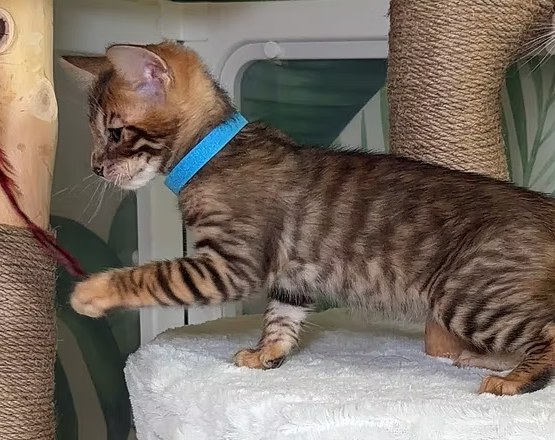
Linda — cropped from a Casa Cruz Ranch update photo
Toygers mature into a big, muscular, athletic cat — that bold, glossy striped coat is the whole point of the breed. Size and coat pattern typically settle in by 2–3 years old.
8/21/26 Updates
Linda at home on the couch, freshly spayed and full of energy
“Yes she is sweet little angel. Her color is very beautiful developing nicely. She looks big in the photos but still a little baby. She was spayed this morning. She's a good girl at the vet, they were like she came out of surgery purring, how do you do it, all your kittens are always so loving and nice. It's the best compliment I always get.”
Pickup Info
A small, family-owned Southern California cattery breeding Toygers, Bengals, and Border Collies since 2019. Their program carries real pedigree weight — TICA's first-ever Lifetime Achievement winner for a Toyger, plus #1 Toyger Kitten and #1 Toyger Cat in the World for 2022 — and every breeding cat is genetically tested and cleared of known hereditary diseases. Kittens are handled daily from birth, and the breeder keeps an open door for the cat's whole life, including help rehoming if it's ever needed.
Visit casacruzranch.comSetup Essentials
The goal for week one is a low-stimulation base camp she controls completely, stocked with exactly what she's already used to.
Before she arrives
- Pick her base room — a spare bathroom, bedroom, or office with a door (or a door + baby gate). This is her entire world for the first several days: litter box, food/water, bed or hide, a scratching post, a couple of toys.
- Have her exact current food in the house before pickup — confirmed as Nulo FreeStyle Chicken & Cod kibble alongside her Darwin's raw. See Food & Coat Health for why matching it matters.
- Start her on pine pellet litter — what she already knows at the ranch. See Litter for low-tracking upgrades once she's settled.
- Book her first local vet visit for the week she arrives. Born April 12, 2026, she'll be a full 20 weeks old at pickup — well past Casa Cruz's 12–13-week alter age. She was spayed at the ranch on August 21, 2026. The visit is mainly to get her records transferred, check the incision has healed cleanly from travel, and confirm everything looks good.
- Activate the Trupanion 30-day free trial within 24 hours of pickup — it's a hard window, so put a reminder on the calendar for 8/31.
First 24–48 hours
- Let her decompress alone in the base room before any dog contact — not even a look through a gate yet. Travel plus a new home is enough novelty for day one.
- Keep her food identical to what she was just eating. No new food this week, no matter how tempting an upgrade looks.
- Skip bathing unless she's genuinely dirty from travel — if needed, CHI cat shampoo is the ranch's own choice.
- Begin the scent-swap step from the dog introduction plan below — it's the one thing that can start on day one.
Every mismatch — new food, new litter, new dogs, new house, all at once — stacks stress on a kitten who's already had a big day. Holding food and litter constant for the first couple of weeks removes two variables, so if anything does go sideways (upset stomach, litter box avoidance) it's easier to tell what caused it.
Meeting Winston & Max
Winston mostly ignores other animals, so his track is light-touch throughout. Max is 5, has puppy-level energy, and barks and gets wound up around cats — his track is the one that sets the pace. Every phase below is gated on his behavior, not the calendar: move on only when he's calm, and go back a step without hesitation if he isn't.
She stays entirely in her base room. No visual contact with either dog yet — this phase is just about smell.
No special handling needed — life goes on as normal for him elsewhere in the house.
Keep him away from the base room door entirely. Let him sniff a towel or blanket that's been in her space, from a distance, and reward calm sniffing.
If she's still hiding or not eating by day 2–3, give her more solo time before moving on — there's no rush here.
Visual intros through a baby gate or a cracked, blocked door. Sessions are short — 1–2 minutes, once or twice a day.
Can be loose and nearby, off leash. He'll likely lose interest fast — that's the expected, good outcome.
On leash, several feet back from the gate. Reward any neutral or calm glance immediately. End the session the moment he fixates or hard-stares — don't wait to see if it escalates into barking.
Stiff body, hard stare, leaning forward → end the session and add distance next time. Whining or pacing with a loose body is fine — just keep the distance where it is.
Max has strung together about five calm sessions in a row at the barrier.
No more barrier, but Max stays on leash (and muzzled too, if he's muzzle-trained — cheap insurance given his history with cats). Make sure she already has a vertical escape route — a cat tree or clear shelf path — established in the room before this phase starts.
Probably fine off leash by now, but keep an eye on the first few sessions regardless.
Short sessions, 5–10 minutes. Close the distance gradually, only while he stays calm. Treat heavily for ignoring her or lying down nearby.
Any lunge or hard fixation sends you back to barrier work (phase 2), not just a smaller step down.
Drop the leash but stay in the room and actively watch. Start with short stretches and lengthen them slowly.
This is typically the longest phase for a reactive dog. Some get here in three weeks; others take two months or more — there's genuinely no fixed timeline, only his behavior.
Don't leave them alone together yet, even on a good day.
"Boring" is the goal — Max not reacting at all is what tells you he's ready. Even once you're here, keep a few habits permanently:
- Separate feeding stations for good, regardless of species
- A dog-free elevated retreat she can always get to
- A litter box location Max can't loiter around or guard
Litter, Without the Tracking
Tracking is mostly solved by the box-and-mat combination, not the litter itself — though the substrate you start her on happens to already be a good low-track choice.
Start with what she knows
Casa Cruz raises kittens on pine pellets (the Tractor Supply bags, changed twice a week) — and that's a genuinely good low-tracking substrate on its own merits, not just a breeder default. Pellets don't crumble into fine dust the way clumping clay does, so there's less loose material to stick to paws in the first place. If you'd rather move to a paper or tofu-based litter later, mix it in gradually over 1–2 weeks so she doesn't start avoiding the box over a sudden switch.
Boxes and mats
-
A grated lid filters litter off her paws on the way out — the single biggest lever for cutting tracking at the source.
-
Dome-and-ramp combo; works especially well paired with a textured mat underneath.
-
Whisker Litter-Robot 4 Box · premiumSelf-cleaning, ships with its own trap mat. The hands-off option if you'd rather not scoop.
-
Dual-layer rubber with a honeycomb top layer that pulls litter out of paw crevices; the top overall pick across most reviews.
-
Hygienic silicone with a raised outer lip so scattered litter doesn't just slide onto the floor.
Keep the box out of main walking paths. Every step across a hallway or rug afterward grinds any escaped litter in further — a mat only has to catch what she carries out in the first few steps.
Catio & a Secure Door
With a yard, a tunnel-connected catio is the cleanest way to give her real outdoor access. Sequence this in after the dog introduction has settled — one new stimulus at a time is enough for the first few weeks.
The "raccoon-proof" door, honestly assessed
Claims here vary more than you'd expect. A standard microchip-reading flap (SureFlap Microchip, PetSafe Microchip) reads her chip and is supposed to unlock only for her — but raccoons have been documented pressing their bodies against the sensor or muscling weak latches open on base models, so build quality matters as much as any one spec. SureFlap's more full-featured model is worth the upgrade regardless:
-
SureFlap DualScan RecommendedThe base model only scans on the way in; DualScan scans both directions, which is really built for selective in/out control across multiple pets (handy if a second cat ever joins the household) — plus a sturdier 4-way manual lock and a safety mode that always lets her back in. Worth it for the more robust build overall, not because dual-scanning itself is what stops wildlife.
-
Marketed specifically as "super selective" for walls and doors — a solid alternative to the SureFlap line.
Building the connection
- Mount the microchip door in an exterior wall or door.
- Confirm the flap swings completely freely before attaching anything to it — a stuck or stiff flap is enough to make a cat abandon the door entirely, sometimes for good.
- Attach a wood-framed tunnel flush against the flap, running to the enclosure.
- Use hardware cloth for the tunnel and catio walls, not chicken wire — chicken wire flexes enough for small claws and determined wildlife to bend it open.
Catio Spaces' Oasis Tunnel plans (8×8 or 8×10) are a solid DIY starting template. Budget roughly $200–500 for a basic DIY tunnel run in lumber, wire mesh, and hardware; a full custom-built catio enclosure runs higher.
Toys & Somewhere to Scratch
A stable scratching surface she actually prefers over furniture, plus a small rotation of toy types rather than one big pile.
Scratching
Look for a vertical sisal post at least 30" tall with a genuinely heavy base — she needs to get a full-body stretch and lean her weight into it without it tipping. A wobbly post trains cats to look elsewhere (i.e. your furniture). The SmartCat Pioneer Pet Ultimate Scratching Post is a good benchmark for height and stability. Place one right next to whatever piece of furniture you're most protective of — proximity beats a perfect post in the wrong room.
Cat tree
A cat tree does triple duty: scratch surface, vertical territory, and — during the dog-introduction sessions above — her safe elevated retreat the instant Max gets too enthusiastic. That last job is why stability isn't optional here the way it might be in a single-cat home; a tree that wobbles when she leaps up defeats the entire point of it being a safe retreat.
Toygers grow into a big, muscular, athletic cat, not a small one, so it's worth sizing up now rather than buying kitten-scale and replacing it in six months. Look for an assembled weight of 35+ lb, a base at least 24″×18″ (wider matters more than taller for tip resistance), and ideally an anti-tip wall-anchor strap — worth using given an excitable dog may be bumping into the base.
-
Frisco 76″ XXL Heavy Duty Cat Tree Top pickComes up best across Bengal-owner reviews specifically — two perches, a condo, and a hammock, with the weight distributed low for real stability under an active, athletic cat.
-
Engineered-wood posts on a wide, weighted base built for energetic breeds; the 82″ version adds two enclosed condos and 8 sisal-wrapped posts if you want to go bigger.
-
A solid mid-price option — the hammock is rated to hold a full-grown adult cat's weight without sagging or destabilizing the frame.
Toy rotation
-
Interactive bonding play with you — the category that matters most for a kitten settling into a new home.
-
PetSafe Slimcat PuzzleAn easy starting puzzle feeder — she bats the ball to release kibble or treats.
-
Nina Ottosson Buggin' Out PuzzleA step up once she's confident with puzzle feeding — 16 hidden treat cups for a slower, more mentally taxing session.
-
ZiggyDoo Cat Wheel Ranch pickCasa Cruz's own recommendation for calorie burn once she's a bit more grown — code INVITATION-CASACRUZ for priority shipping.
Trim her nails every 7–10 days with baby nail clippers — the ranch's own routine. It's worth keeping up specifically during the dog introduction: blunter claws lower the stakes of any startled swipe in Max's direction.
Food & Coat Health, In Depth
The toyger's entire look rides on a bold, glossy striped coat — so the general "excellent kitten nutrition" playbook matters more visibly on her than on most cats. There's no unique toyger dietary requirement beyond that; she's a large, athletic, muscular shorthair.
What actually drives shine
The single most visibly impactful nutrient here — and the most commonly under-dosed in standard formulas.
Supports the skin barrier itself, which the coat sits on top of.
Strengthens the hair follicle from the root.
Zinc (meat, fish) aids skin repair; vitamin E is the antioxidant that keeps skin from drying out.
Expect roughly 4–6 weeks before any nutrition change is visible in the coat — her current fur has to shed out before the new, better-fed coat grows in. Don't judge a food switch earlier than that.
The good news about her current food
The ranch confirmed the exact recipe: Nulo FreeStyle High-Protein Kibble, Chicken & Cod — and it's a genuinely strong pick for coat health specifically, not just a placeholder breeder brand. First four ingredients are deboned chicken, chicken meal, turkey meal and deboned cod; roughly 83–90% of the protein is animal-sourced, it's grain-free, and the omega-3/omega-6 from fish is exactly the fatty-acid profile that keeps a coat glossy. It's labeled complete and balanced for all life stages, so it covers her growth phase without a separate kitten formula. Two reasons favor staying on it through at least the first month home: it already hits the marks above, and swapping food during a stressful relocation is one of the more common ways to trigger GI upset on top of everything else that's new.
If you compare options later
| Food | Coat-relevant ingredients | Best fit | Verdict |
|---|---|---|---|
| Nulo FreeStyle Chicken & Cod Current |
Fish-sourced omega-3/6, 83–90% animal protein | Already what she's eating | Keep unless a specific reason to switch comes up |
| Hill's Science Diet Kitten | Explicit fish oil with DHA + EPA | #1 vet-recommended overall | The strongest alternative if you ever do switch, specifically for coat |
| Purina Pro Plan Kitten | High protein + probiotics | General growth & digestive support | No added omega-3 source — a real gap for this particular goal |
| Royal Canin Kitten | Varies by formula | A specific vet-flagged condition | More a specialty pick than a coat-focused one |
If you do switch, ever, transition over 7 days to avoid GI upset: 25% new / 75% old for two days, 50/50 for two days, 75% new / 25% old for two days, then 100%.
Raw feeding, explained
Casa Cruz's other supported option — recipes provided on request — is a raw diet, sometimes labeled BARF ("biologically appropriate raw food," or "bones and raw food"). The ranch currently sources through Darwin's Pet. Since you asked specifically what raw feeding means and what it takes to do well, here's the real picture, not just the marketing version.
- 2× Darwin's Natural Selections Raw Poultry Blend for Cats
- 2× Darwin's Natural Selections Premium Chicken Cat Food
- 1× Darwin's Natural Selections Premium Beef Cat Food
Keeping this noted as a reference — useful for matching proteins/flavors she already likes whenever we land on a brand with a cleaner safety record.
As of this month, the Department of Justice has sued Darwin's specifically, seeking to halt production until it meets federal food-safety requirements — citing a decade of recalls and pathogen contamination (Salmonella and Listeria) in roughly two-thirds of recent FDA samples. The complaint centers on a documented 2024 case: a family dog fed Darwin's exclusively fell ill, and whole-genome sequencing matched E. coli from an unopened package of that food to the E. coli that caused a 4-year-old child in the same household to develop hemolytic uremic syndrome and chronic kidney disease. Darwin's reportedly has not recalled the implicated products. Worth raising directly with Casa Cruz, and worth weighing before continuing this specific brand once she's home — independent of the general raw-feeding tradeoffs below.
What it actually is: uncooked meat, edible bone, and organ, meant to mirror what a cat would get from eating whole prey. Each part does a specific job — muscle meat provides protein and moisture, bone provides calcium and phosphorus in the right ratio, and organs (especially liver and heart) provide taurine, vitamin A, and other nutrients that are hard to get anywhere else. A raw diet fed this way, in the right proportions, can be nutritionally complete. Fed carelessly, it very often isn't.
What "doing it properly" requires
- A genuinely complete recipe. Commercial raw products are labeled either "complete" (fine as a sole diet) or "complementary" (a topper, not a full diet) — that word matters. A homemade recipe needs the same rigor: correct meat-to-bone-to-organ ratios, not eyeballed.
- Taurine, specifically. Cats can't synthesize taurine themselves and need it daily. Whole-prey-style raw with real organ content (heart, liver) generally covers it. Ground raw is the riskier case — grinding exposes more surface area to air, which oxidizes and degrades taurine, so ground homemade diets often need it supplemented directly.
- A calcium:phosphorus source. Either real edible bone content or a bone-meal/mineral supplement standing in for it — this ratio is especially unforgiving for a still-growing kitten.
- A vitamin/mineral premix, if it's a homemade (not commercially formulated) recipe — whole prey provides a wider nutrient spread than muscle meat and organs alone can replicate.
- Real kitchen discipline. Separate cutting boards and utensils from your own food prep, hand-washing after handling, dedicated fridge/freezer storage, and prompt bowl cleanup after each meal.
Studies of commercial raw pet food have found meaningful contamination rates — one found E. coli in nearly 60% of samples tested and Salmonella in about 7%; harmful bacteria including Listeria have shown up in others. The AVMA, CDC, and FDA all officially discourage raw feeding on those grounds, for the pet's sake and for the humans handling and living around the food. Kittens are specifically named as higher-risk, alongside seniors and anyone immunocompromised in the house, because of their less mature immune systems. With two dogs also in the house who'd happily investigate a dropped scrap, this isn't a hygiene detail to skip.
Cats have a short, acidic digestive tract that moves food through in around 12 hours, which gives bacteria comparatively little time to establish before it passes — part of why cats themselves tend to tolerate raw better than the humans handling it do. A small study feeding kittens a raw rabbit diet found improved stool quality within a week. It's a real upside, just not one that offsets the handling risk on its own.
Comparing the raw brands
If a switch ever makes sense, worth knowing how the major raw brands actually compare — not just on price, but on documented safety history. This is what a bit of digging turned up, current as of this month:
| Brand | Approx. cost | Safety history |
|---|---|---|
| Darwin's Ranch's current source |
~$1.01/day per cat (subscription, shipped) | Active DOJ lawsuit (filed Aug. 2026) seeking to halt production; a decade of recalls; roughly two-thirds of recent FDA samples contaminated; a 2024 case genetically linked to a child's severe E. coli illness; has not recalled the implicated products |
| Stella & Chewy's Cleanest record |
~$8/lb (raw morsels/canned) | Two Listeria recalls, both in 2015; nothing since — clean for 10+ years. HPP-processed (SecureByNature) |
| Primal | ~$4.50/lb MSRP; ~$1.12/day per cat | 2011 Salmonella recall; 2015 thiamine deficiency found; 2019 FDA inspection found no written recall plan plus dozens of pathogen-positive lots; 2022 more Listeria plus 51 further positive results; Feb. 2023 formal FDA warning letter called corrective steps insufficient; another recall in 2025 |
| BARF World | ~$4–8/lb (typical for frozen raw patties) | One precautionary recall in 2013 (no confirmed contamination, no illnesses reported); nothing since. HPP-processed, USDA-inspected meat |
Pricing is approximate and pulled from different sources in different units (per day vs. per pound), since actual cost depends on portion size and format — treat these as ballpark, not quotes.
If you want to explore it: ask Casa Cruz directly whether they're aware of the current DOJ action, and whether their recipe is formulated to AAFCO standards for growth (kitten) specifically, not just maintenance — a growing kitten has much less margin for error on the calcium:phosphorus ratio than an adult cat. It's also worth a quick check-in with your vet before switching a kitten onto it, precisely because she's still growing. Given she's already doing well on a complete, coat-supportive kibble, there's no need to decide this in week one — it's worth knowing how to do properly, not worth rushing into.
One more option worth knowing about
Salmon oil add-in — a pump or capsule is the single highest-leverage addition if you want more shine than diet alone gives. Since Nulo already includes salmon oil, treat this as a nice-to-have rather than a gap to fill.
Quick Shopping List
Everything above, condensed — and doubling as the order log. Anything already bought is checked off with the exact product and a link to its page.
Setup
-
OrderedPaw Ballet Foldable Pet Kitten Playpen — waterproof, retractable shade cover, carrying case · $47.99
Litter upgrade
-
OrderedIRIS USA Large Top Entry Litter Box — hooded privacy, beige/white; grooved lid doubles as a tracking mat and the top entry keeps Winston and Max out · $39.99
-
OrderedSiiPet LitterLens — AI camera that clips onto whatever box she's using and flags changes in urination or stool
Catio & doors
-
OrderedPawras Escape-Proof Cat Harness + Leash ×2 — orange/blue S (up to 5 lb) for now, pink/blue M (5–10 lb) as she grows · $79.85
-
OrderedAirTag Cat Collar Breakaway, 2-Pack — reflective, with bell, holds an Apple AirTag for Find My tracking · $16.99
Enrichment
Food & coat
-
ConfirmedNulo FreeStyle High-Protein Kibble, Chicken & Cod — buy a bag before pickup so she never runs out
-
OrderedStella & Chewy's, on an 8-week recurring subscription — the cleanest safety record of the raw brands compared above. Chicken and poultry carry over from her Darwin's rotation; the beef slot became fish, which adds omega-3 for her coat.Freeze-dried raw dinner morsels — 18 oz each
- Yummy Lickin' Salmon & Chicken$46.99
- Sea-Licious Salmon & Cod$46.99
- Chick, Chick Chicken$46.99
Meowfulls treats — 1.5 oz, 2-packs- Chicken & Chicken Liver$15.99
- Turkey & Duck$15.99
- Whitefish & Salmon$17.99
The three morsel recipes are formulated to AAFCO nutrient profiles for all life stages, so they're cleared for a growing kitten — and feeding directions note kittens may need up to twice an adult portion. The Meowfulls are treats only, capped at 10% of her daily calories.
Ordered Aug 19, 2026 · total $190.94 Next delivery Oct 14, 2026